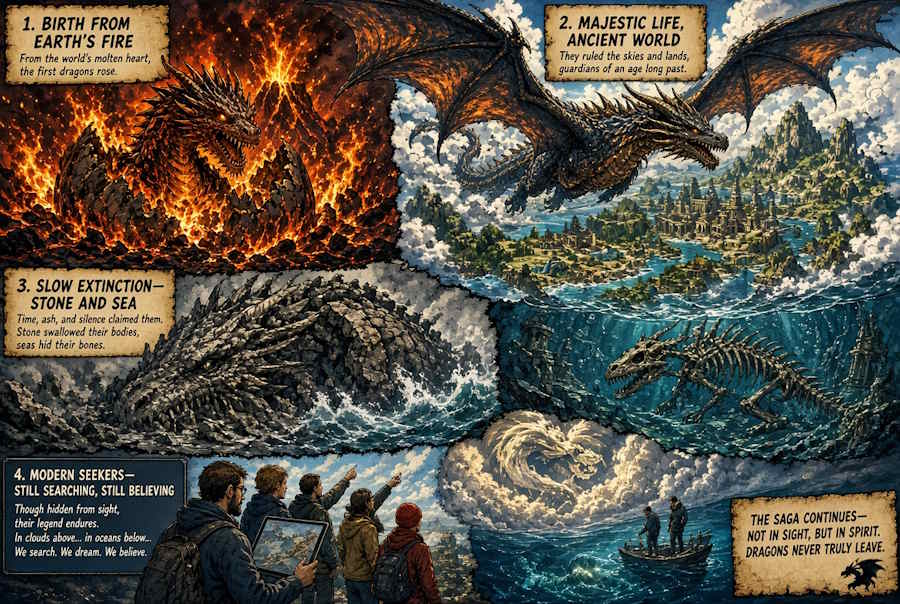
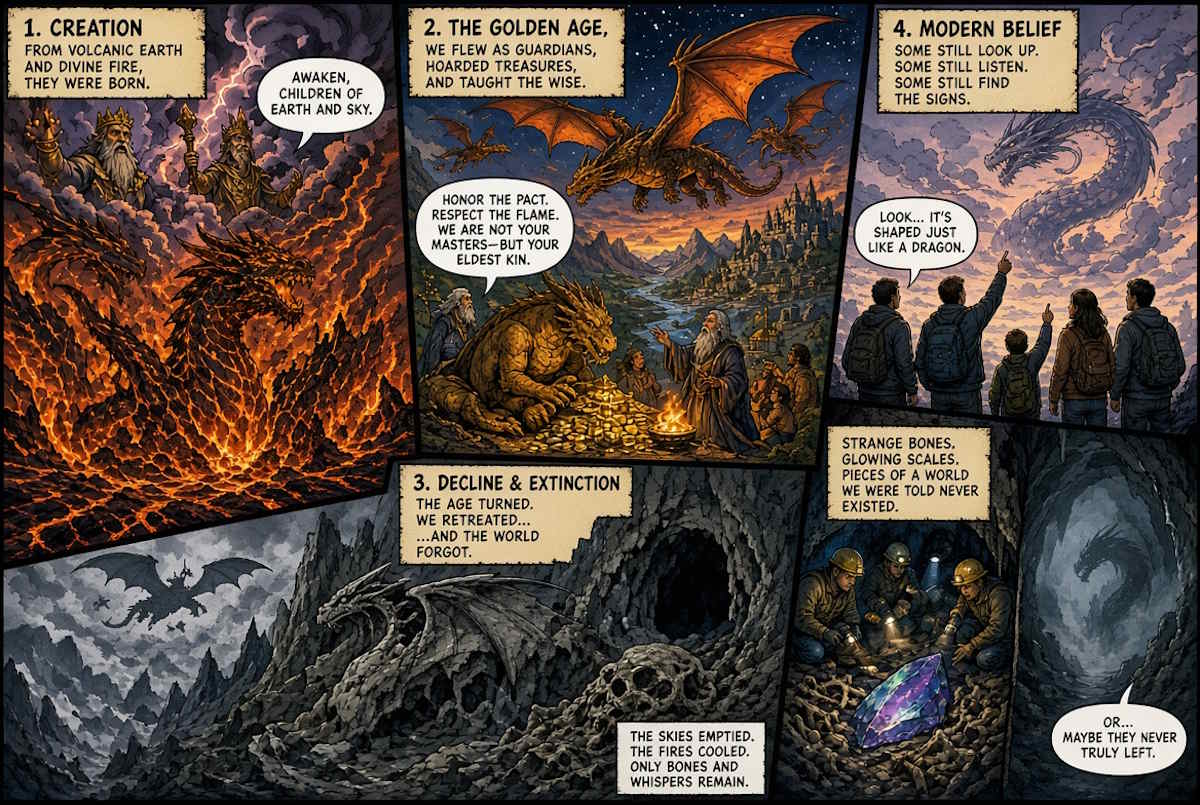
In the beginning, when the world was still young and the mountains were still soft, the first dragons rose from the breath of the earth. Ancient myths tell of a time when the gods united the heavens and the underworld. From this union emerged a being that embodied both realms: the heaviness of stone and the lightness of the wind. Thus, the dragons were born—creatures of fire and scale, of pride and ancient wisdom.
They were no mere monsters. In those early ages, they lived as guardians. Some watched over the springs of life, others the treasures of the mountains, and still others the dreams of humankind. Their wings parted the clouds, their fire illuminated the nights, and their song—a deep, rumbling hum—could make rivers dance or lull entire valleys to sleep. The people of that era both feared and revered them. Some tribes offered sacrifices, while others learned from the dragons the language of the stars and the art of taming fire.
Yet the world changed. Humanity grew in number and power. People built cities of stone, forged swords, and began to impose order upon the wilderness. The dragons, once free to soar across continents, found their domain shrinking. Some retreated to the highest peaks, others to the deepest ocean caverns. The great conflicts between humans and dragons—known in legend as the “Dragon Wars”—were less heroic battles than a slow, painful retreat. Dragons became scarce. Their nests lay empty. The fire in their veins gradually faded, like a candle starved of air.
Most dragons died out—not in a single day, but over the course of centuries. Some turned to stone in the mountains, becoming the strange rock formations still found in distant lands today. Others sank into the sea, becoming the stuff of legends about sea monsters. The last of them, so the story goes, settled into the deepest sleep the earth has ever known—a slumber that can last for millennia.
And yet, to this day, some believe that dragons have not entirely vanished.
There are people in remote valleys who hear a distant rushing sound at night—a sound that neither wind nor water can explain. Others discover scales in ancient caves that belong to no known creature, or bones whose shapes baffle scientists. Dragons appear time and again in the myths of many peoples—from China and Europe to the islands of the South Pacific—as if they had never truly left. Some say dragons learned to hide: in the clouds, in the ocean depths, or even within human dreams. Others believe they are simply waiting—waiting for a time when the world is wild enough once more to endure their presence.
Perhaps the belief in dragons is itself the last fire remaining of them. As long as people tell stories of beings greater than fear and older than time, a part of the dragons lives on. Not as flesh, blood, and flame—but as a possibility. As a reminder that the world was once more magical. And perhaps, very quietly, as a promise that it could become so again.
How Dragons Used to Party
(An absolutely true and scientifically unconfirmed story)
Back in the days when mountains were still soft and humans weren’t quite so sensitive, dragons threw the best parties in the world.
It always started the same way: a dragon would have a birthday, catch an especially large sheep, or simply be bored. Then, he would let out a long, deep call that echoed across entire continents. Within a few hours, they would show up—red, green, black, and gold dragons, and even the shy purple ones from the Misty Mountains. The meeting place was usually an extinct volcano; after all, it already had the right atmosphere, and the seats were practically pre-heated.
What followed was legendary.
First, the fire was lit. Not just any small campfire—no. Three older dragons positioned themselves in a circle and breathed flames until the entire rim of the crater glowed like a giant birthday candle. Then came the food: roasted mammoth, crispy giant elk, and—the absolute highlight—flambéed whale (which had to be fetched specially from the sea and was always a bit too salty).
The music was provided by the youngest dragons. They flew in formation, using their wings to create deep bass sounds, while older dragons drummed their tails against the rocks. It sounded like a mix of a thunderstorm and heavy metal—only louder.
And then came the highlight: the fireworks.
One by one, each dragon breathed the wildest flame patterns into the sky. There were hearts, dragon heads, and even—on one occasion—a portrait of a particularly unpopular neighboring dragon (which caused quite a bit of laughter). One especially talented blue dragon could even write letters. At one point, the words “WE ARE THE KINGS” hung in the night sky for hours until the wind blew them away.
Of course, there were the usual party mishaps, too:
A young dragon drank too much molten gold and had to hang over the crater’s edge all evening, retching it up (it looked like an expensive waterfall).
Two dragons started arguing over who had the better fire-dance moves and accidentally set half the forest ablaze. The solution: everyone flew over and extinguished the fire with their wings. Afterward, they went right back to dancing.
Once, a particularly drunk dragon got the idea to “surf” on an entire mountain. He slid down the slope, taking three smaller mountains with him, and didn’t land until he was three valleys away. The others applauded anyway. Towards morning, as the sun rose and everyone lay completely exhausted on the warm stones, the same phrase was always uttered:
“Next time, we’ll do it on a smaller scale.”
Of course, that never happened.
The people in the valleys below heard only a distant rumble, saw lights in the sky, and later told stories of “festivals of the gods” and “signs from the heavens.” In truth, it was just a standard dragon party. With a bit too much fire, a bit too much food, and a whole lot of bad decisions. And that is exactly how they celebrated—loudly, hotly, and with total irresponsibility. Until, eventually, there were too many humans, the forests became too small, and the dragons grew too tired for such an undertaking. But sometimes, deep in the mountains, a faint rumble can still be heard at night.
That’s when the old dragons know: somewhere out there, someone is planning a party again.